Research & Practice Series · Journal 4.1 · 25 September 2026
The Long Walk Home: Finding My Way Back to Purpose
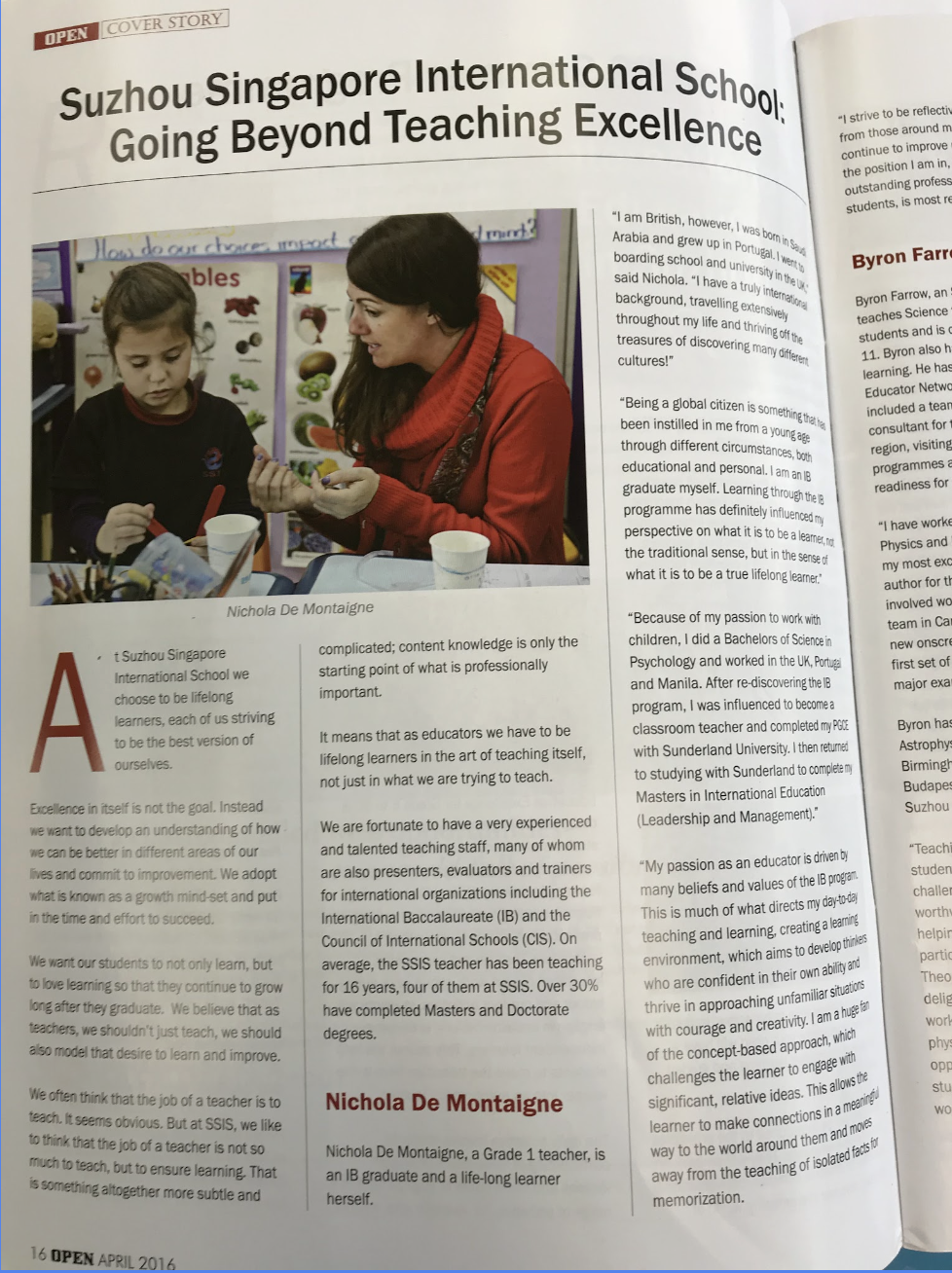
I found this page again recently. It was published in 2016, when I was teaching Grade 1 at Suzhou Singapore International School. Reading it now, ten years later, I can see something I could not fully see then: the thread was already there.
I spoke about being a lifelong learner. I spoke about education as something much larger than the teaching of isolated facts. I wrote that a teacher's role was not simply to teach, but to ensure learning, something altogether more subtle and more complicated. I spoke about creating an environment in which children could approach unfamiliar situations with courage and creativity, make connections, and understand the world around them.
At the time, these felt like convictions I had arrived at through study and practice. Now I can see how much earlier the journey began.
The walks that stayed with me
When I was a child, I went on long walks on Guincho beach with Thomas Andrew Bull, my stepfather. We walked no matter the weather.
Walking is a wonderful time to talk, but it is also a wonderful time to listen. Andrew was a historian, a lover of his dogs, and the Headmaster of St Julian's School in Carcavelos. I did not walk beside him thinking that I was being taught about leadership, education or purpose. I was simply a child, walking beside someone who mattered deeply to me.
But children notice how adults inhabit the world. They notice what makes us curious, what we pay attention to and how we speak about other people. They absorb the questions we return to and the values we live, often long before either the child or the adult can name what is being passed on.
I did not fully understand Andrew's impact on me then. I am still understanding it now.
I did not set out to become a teacher
My professional journey began with developmental psychology and a passion for supporting children and young people to feel that they belong, no matter what. I worked with young people whose behaviour often spoke before they had the language, safety or trust to explain what sat underneath it. That experience left me with a question that has followed me throughout my life: what changes when a child is truly seen?
I fell into education, although looking back, perhaps it was less of a fall and more of a return. Andrew's influence was there, even when I did not consciously recognise it. So was my own experience of moving between cultures, languages and different ideas of home.
At St Dominic's International School, I began to exercise my passion for inclusion more fully. I became, and remain, a fierce advocate for neurodivergent learners. Not because inclusion is a programme or a department, but because every child deserves to enter a learning community without having to disguise who they are in order to belong.
Education gave all the strands of my life somewhere to meet: developmental psychology, identity, belonging, curiosity, culture, inclusion and the belief that a child's strengths and interests are not peripheral to learning. They are often the way in.
The journey between there and here
The path home was not a straight one. It took me through Manila, China and Brazil, across classrooms, cultures and communities that each changed how I understood children, learning and leadership. Every place asked me to listen again. Every move widened my sense of what education could be when it begins with the whole child rather than a fixed idea of who that child should become.
In Norway, I became a Founding Head. Building from the beginning brought the strands closer together: the values we write down, the adults we invite in, the culture created through ordinary decisions, and the courage required to turn belief into daily practice. I learned that founding is not simply opening something new. It is holding a purpose steadily enough for other people to see themselves within it.
I also founded DeMontaigne Life Design, bringing my work around purpose, people, place and practice into a wider conversation about how we design lives, learning and communities with intention. It gave language and form to ideas that had travelled with me for years.
Manila, China, Brazil and Norway were not detours away from home. They were part of the long walk home. Each place gave me something I needed; each role brought the picture into clearer focus. Together, they carried me towards the right place: back to Cascais, ready to bring everything I had learned into ISI.
What I knew in 2016
In that magazine article, I said that my passion as an educator was driven by the beliefs and values of the IB programme. I wrote about concept-based learning that enables learners to engage with significant, relevant ideas, make connections and move away from memorisation.
I still believe every word.
What has changed is that I can now see the longer story around those words. The teacher pictured at that table was carrying the influence of a man who had led one of the world's most respected schools, even if she had not yet understood the depth of that inheritance. She was carrying the child who had walked Guincho in every kind of weather. She was carrying the psychology graduate who wanted children to feel they belonged, and the inclusion advocate who could see how often schools asked neurodivergent learners to adapt without asking whether the environment should change too.
She was already moving towards ISI Cascais. She just did not know its name yet.
A full-circle moment
This month, many people have been getting in touch about ISI Cascais. They are curious. They are applying. They are sending CVs and asking what it might mean to be part of a school built in this way. It is an exciting time for me, not simply because a team is beginning to form, but because every conversation brings me back to the question of who we choose to build with.
I am not looking only for people who can deliver content. As I wrote in 2016, content knowledge is the starting point of what is professionally important. I am looking for adults who remain learners themselves; people who know that teaching is relational, complex and deeply human. People who are curious about the child behind the behaviour, who recognise difference as a source of possibility, and who understand that belonging and high expectations are not opposites.
Perhaps that is part of Andrew's influence too. Leadership is not only what we announce. It is what other people come to understand by walking beside us.
Coming home
There is something profoundly full circle about building ISI Cascais here. The coastline of my childhood is becoming part of the landscape in which a new generation will learn. The questions that shaped my studies and early work are becoming the foundations of a school. The beliefs I articulated in China in 2016 are returning home with me, tested, deepened and made more urgent by every child, family, teacher and community I have learned from since.
Purpose rarely arrives as one dramatic revelation. Sometimes it forms quietly through the people who influence us, the work that keeps calling us back, the places that hold our memories and the questions we cannot stop asking. We may only recognise the pattern when we have travelled far enough to look back.
I did not know, on those walks at Guincho, what Andrew was giving me. I did not know, when I began studying developmental psychology, that education would become the place where my passions converged. I did not know, when that magazine page was printed, that I would one day return to Cascais to build a school of my own.
But the thread was there.
Now I can see it. And now, with ISI Cascais, I have the privilege of carrying it forward.
Continue the conversation
If this resonates, there is a place for you here.
We are building a warm community around children who learn, think and belong in different ways.
For families
Want to know more? Book a call with Nichola.
A relaxed conversation with Nichola, before anything is decided. Ask about the studios, the daily rhythm, the fees, or what your child would find here.
Every enquiry is answered personally, usually within two working days.