Research & Practice Series · Journal 4 of 4 · 25 September 2026
From belonging to purpose: what becomes possible when a child is truly seen
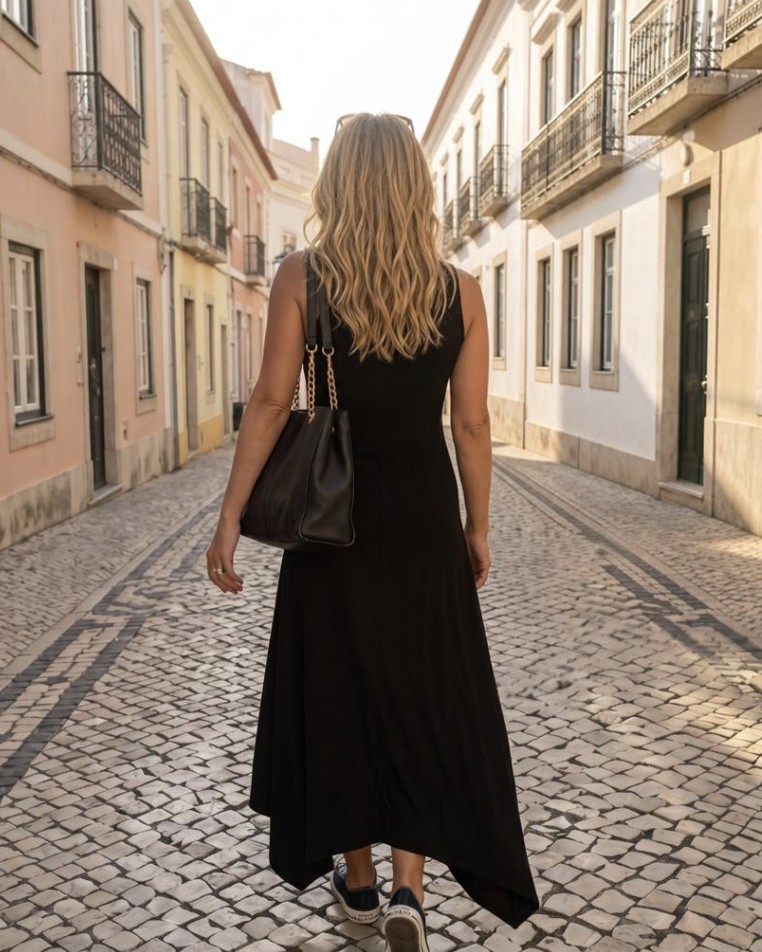
I was walking through the old town with my ten-year-old when she took this photo.
It is a walk I have done many times in my life, most of those with my step-father. A historian. A lover of his dogs. The headmaster of one of the most prestigious schools in the world, St. Julian's, in Carcavelos. I have walked those streets in his company more times than I can count.
This day, I was walking it thinking about belonging. As always.
And somewhere between the third turning and the sea, the question I was carrying settled into something I could actually hold: once a child knows they belong, what becomes possible?
My first article in this series was about belonging, what the data says, and the community we are choosing to build at ISI Cascais. But belonging was never meant to be the whole answer. Belonging gives a child a secure place from which to explore. Purpose gives that exploration direction. A child can be physically present in a classroom and still feel there is no place for them there. They may comply, disappear into silence, mask what makes them different, or express distress through behaviour adults experience as difficult. What looks like defiance is often a child asking a more fundamental question: Do you see me, and is there room here for who I really am?
Across more than twenty-five years in education and psychology, different countries, cultures, generations, identities, I have met the same need beneath very different lives. I have worked with children whose distress became aggression, including children who hit me in school, and with people whose lives became entangled with crime. Their histories were not identical and their behaviour cannot be explained by one cause. Yet again and again, beneath the behaviour, was a human need to be seen, understood and valued.
Belonging is not conformity
We often confuse belonging with fitting in. They are not the same. Fitting in asks a person to study the rules of a system and edit themselves until they are accepted. Belonging allows a person to participate without abandoning their identity. It combines connection with agency: I am part of this community, and I do not have to disappear inside it.
Systems are human constructions. Schools, timetables, measures of success, assumptions about intelligence, all designed by people, and all redesignable by people. The answer is not to reject every system. Children need structure, boundaries, knowledge and shared responsibility. The task is to build structures that help them understand themselves, rather than structures that decide, too early and too narrowly, who they are allowed to become.
As Article 1 explored in detail, connection is protective. It does not erase poverty, trauma or inequality. It can change how a young person understands themselves and expand the futures they are able to imagine. Belonging is not the destination. It is the ground from which agency, curiosity and purpose grow.
Purpose as an inner compass
The Japanese have a concept I love: ikigai, often translated as a reason for living. It describes the sense that life is worth engaging with. Japanese cohort studies have associated this sense of purpose with wellbeing and longevity, though purpose is one factor among many and no single explanation for anything. I think of it less as a destination and more as a compass.
For education, the important idea is not that every child must choose a permanent career or discover one perfect answer. Purpose should never become another test to pass. It is an evolving set of questions that can accompany a child through changing stages of life:
What do I love and return to naturally?
What am I learning to do well?
What does my community need?
How can I contribute in a way that feels meaningful?
What kind of life allows me to remain connected to myself and to others?
When children meet these questions early, they begin to develop language for their interests, strengths, values and responsibilities. They learn that passion is not merely a private pleasure, it can be channelled into skill, service, enterprise, art, care, innovation or stewardship. They also learn that purpose can change without becoming meaningless. The compass remains useful even when the destination evolves.
What this means for ISI Cascais
ISI Cascais is being designed around a simple proposition: education should help every learner build the knowledge, relationships, confidence and reflective capacity to author a meaningful life. Belonging and purpose are not wellbeing activities placed politely beside the curriculum. They are design principles for the curriculum, the culture and the decisions adults make around each child.
Purpose, regular reflection on interests, strengths, values and contribution, with room for purpose to evolve.
People, adults who know learners well, listen beneath behaviour and build trusted partnerships with families.
Place, a learning environment that uses Cascais, nature, culture and community as part of the curriculum.
Practice, inquiry, real projects, feedback, repair, and opportunities to turn curiosity into meaningful action.
This is our PPPP Compass, Purpose, People, Place, Practice, carried alongside the WEITS pillars of Wellbeing, Entrepreneurship, Innovation, Technology and Sustainability. Together they stop purpose from becoming an abstract exercise. A learner's interests are connected to people, context, disciplined practice and the realities of the world they will help shape.
Seeing the person beneath the behaviour
A belonging-centred school does not excuse harmful behaviour. Safety, accountability and boundaries remain essential. The difference is that discipline is not limited to punishment or exclusion. Adults stay curious about what the behaviour communicates, teach the skills needed for repair, and help the learner re-enter the community with dignity and responsibility.
The questions change. From 'What is wrong with this child?' to 'What is happening around and within this child? What need, skill or relationship is missing? What must be repaired, and what responsibility can the learner now take?' This is not a softer standard. It is a more demanding one, it requires both care and accountability, both individual understanding and responsibility to the group.
The education of a life
Most adults have been asked what they do. Far fewer have been helped to explore why their lives matter to them, where they feel most alive, or how their abilities might meet a genuine need. If we wait until adulthood to ask those questions, many people spend years recovering from identities that were assigned to them by systems, expectations and fear.
We begin earlier. We want children to acquire rigorous knowledge and powerful skills, and to recognise themselves in what they are learning. To experience belonging without conformity, purpose without pressure, freedom joined to responsibility. Education should not produce identical answers. It should equip each learner with better questions, trusted relationships and the courage to keep refining a meaningful answer across a lifetime.
When children know they are seen, they are not protected from every difficulty. They become better equipped to meet difficulty without losing themselves. That is the possibility at the centre of ISI Cascais: a school designed not only to prepare children for the world, but to help them understand how they want to belong to it, and what they are ready to contribute.
That was the thought I carried home this morning, past the shutters opening and the cobbles still cool from the night. The children are coming. The ground is being prepared. Now we help them find their direction.
With care, Nichola
Continue the conversation
If this resonates, there is a place for you here.
We are building a warm community around children who learn, think and belong in different ways.
For families
Want to know more? Book a call with Nichola.
A relaxed conversation with Nichola, before anything is decided. Ask about the studios, the daily rhythm, the fees, or what your child would find here.
Every enquiry is answered personally, usually within two working days.