Timetable

A Week at ISI Cascais

From Mentor Monday to Future Friday, a rhythm of inquiry, collaboration, adventure, deep work and enterprise.

The Agentic Entrepreneurship Inquiry Cycle

A Week at ISI Cascais is built on structured inquiry with voice and choice.

Not a rigid timetable. A responsive rhythm. Every stage is intentionally designed so learners experience both the security of structure and the autonomy of real choice, and a glowing Metacognitive Core of self-efficacy and reflection fuels every move a learner makes, from first wonder to launching a venture.

MetacognitiveCoreSELF-EFFICACY · REFLECTION01
Immerse & Question
Activating Agency
"What systemic problem matters to me?"
02
Diagnose & Strategize
Engineering Self-Efficacy
"What skills am I missing, and how will I get them?"
03
Build & Deepen
Deep Understanding
"Am I fixing a root cause, or just a surface symptom?"
04
Prototype & Iterate
Self-Knowledge Crux
"How do I pivot my strategy based on real-world data?"
05
Pitch & Validate
Empathy & Explanation
"How effectively am I stepping into my user's shoes?"
06
Launch & Pivot
Ultimate Mastery
"What are the new limits of my understanding?"
Woven links, energy flows in every directionThe Metacognitive Core pulses through every nodeHover or tap a node, watch its connections light up

Wonder & Provoke

Mentor Monday

Connect and imagine.

Inquire & Collaborate

Team Tuesday

Collaborate and inquire.

Explore & Discover

Wild Wednesday

Explore and discover.

Deepen & Create

Thinking Thursday

Deepen and create.

Reflect & Launch

Future Friday

Reflect and contribute.

The 6–8 week PYP inquiry spiral · how a week fits the bigger arc

From Wonderto Enterprise.

Every inquiry begins with carefully designed provocations and expert guidance. As confidence grows, children gradually take increasing ownership of the questions they ask, the investigations they pursue and the actions they choose to take. Families, educators, community partners and expert practitioners enrich the journey throughout, ensuring every inquiry remains both academically rigorous and deeply human.

One unit of inquiry = 6 to 8 weeks. Eight clear milestones. A cycle that loops back and forth, even within a single day, so learners revisit, refine, and go deeper. Every learner reaches Stage 08 · Enterprise to share their learning before the unit closes.

Grounded in the work of Kath Murdoch and H. Lynn Erickson, two of the most cited voices in inquiry-based and concept-based learning worldwide.

Stage 01 · Week 1

Wonder · Notice. Question. Imagine.

WK 1WK 2WK 3WK 4WK 5WK 6WK 7WK 80102030405060708

The cycle loops back and forth

A learner might revisit Tune In after Experiment, or move from Make back to Investigate. This looping can happen in a single day or across a whole unit. What matters is that by the end of each 6–8 week unit, every learner reaches Stage 08 · Enterprise to share their learning with the community.

Different learners · Different paces · Same inquiry

The 8 milestones, step by step

Same cycle, listed linearly for clarity.

  1. 01

    Wonder

    Notice. Question. Imagine.

    Week 1

  2. 02

    Tune In

    Connect to prior knowledge & passions.

    Week 1–2

  3. 03

    Investigate

    Research, interview, observe, gather.

    Week 2–3

  4. 04

    Experiment

    Test, prototype, iterate, reflect.

    Week 3–4

  5. 05

    Make

    Build, design, write, compose, code.

    Week 4–5

  6. 06

    Share

    Exhibit, perform, publish, present.

    Week 5–6

  7. 07

    Act

    Service, advocacy, real-world change.

    Week 6–7

  8. 08

    Enterprise

    Execute. Launch. Make a venture of it.

    Week 7–8

Growing Agency

Teacher LedChild Led

Children gradually move from supported inquiry towards increasing independence, ownership and leadership.

  1. 01

    Teacher Designs

    • Teacher introduces the provocation.
    • Models thinking.
    • Creates psychological safety.
  2. 02

    Shared Inquiry

    • Questions emerge together.
    • Teacher scaffolds.
    • Children contribute.
  3. 03

    Guided Choice

    • Children begin making meaningful decisions.
    • Teacher provides challenge and support.
  4. 04

    Child-Led Inquiry

    • Children increasingly direct investigations.
    • Teachers coach, question and extend thinking.
  5. 05

    Agency in Action

    • Children create. Serve. Lead. Innovate.
    • Launch authentic projects that contribute to the wider community.
Unit ofInquiryChildFamilyTeacherCommunityExpert-in-ResidenceHuman-led

Hover or tap a node

  • Child
  • Family
  • Teacher
  • Community
  • Expert-in-Residence
  • Human-led AI
  1. 01Shared Questions↓
  2. 02Authentic Experiences↓
  3. 03Enterprise↓
  4. 04Community Impact

The curriculum provides the destination. Our community shapes the journey.

The Programme of Inquiry defines the concepts every learner explores. The people within our learning community, children, families, educators and partners, bring those concepts to life through their questions, strengths, experiences and contributions.

No two years at ISI will ever be identical, because no two communities are ever the same.

The research behind the cycle

Two researchers. One clear method for learning that lasts.

Research · 2015Cited 2,400+ times in PYP literature

Kath Murdoch

Author, The Power of Inquiry (2015)

"Inquiry is a stance, not a strategy."

Murdoch's cycle, tune in, find out, sort out, go further, make conclusions, take action, is recursive. Returning to earlier stages isn't a detour; it's where the deepest thinking happens.

Why it matters for our children: they learn to think in cycles, not lines. They get comfortable revisiting ideas, refining them, and acting on what they discover.
Research · 2017Foundation of IB concept-based learning

H. Lynn Erickson

Co-author, Concept-Based Curriculum and Instruction for the Thinking Classroom

"Facts are the foundation. Concepts are the transfer."

Erickson's Structure of Knowledge shows learning becomes transferable only when facts and skills are synergistically linked to concepts and generalisations. Each cycle lifts thinking up the structure.

Why it matters for our children: they don't just complete a unit. They build durable, transferable understanding they carry into MYP, into enterprise, into life.

Sources

  • Murdoch, K. (2015). The Power of Inquiry: Teaching and learning with curiosity, creativity and purpose in the contemporary classroom. Seastar Education.
  • Erickson, H. L., Lanning, L. A., & French, R. (2017). Concept-Based Curriculum and Instruction for the Thinking Classroom (2nd ed.). Corwin.
  • International Baccalaureate Organization (2018). Learning and teaching (Primary Years Programme framework).

At a glance

One Week. One Community. Endless Possibilities.

Mentor Monday

Connect and imagine.

Set goals and establish purpose.

Team Tuesday

Collaborate and inquire.

Co-construct understanding.

Wild Wednesday

Explore and discover.

Learn in context.

Thinking Thursday

Deepen and create.

Apply what we know.

Future Friday

Reflect and contribute.

Act, celebrate and grow.

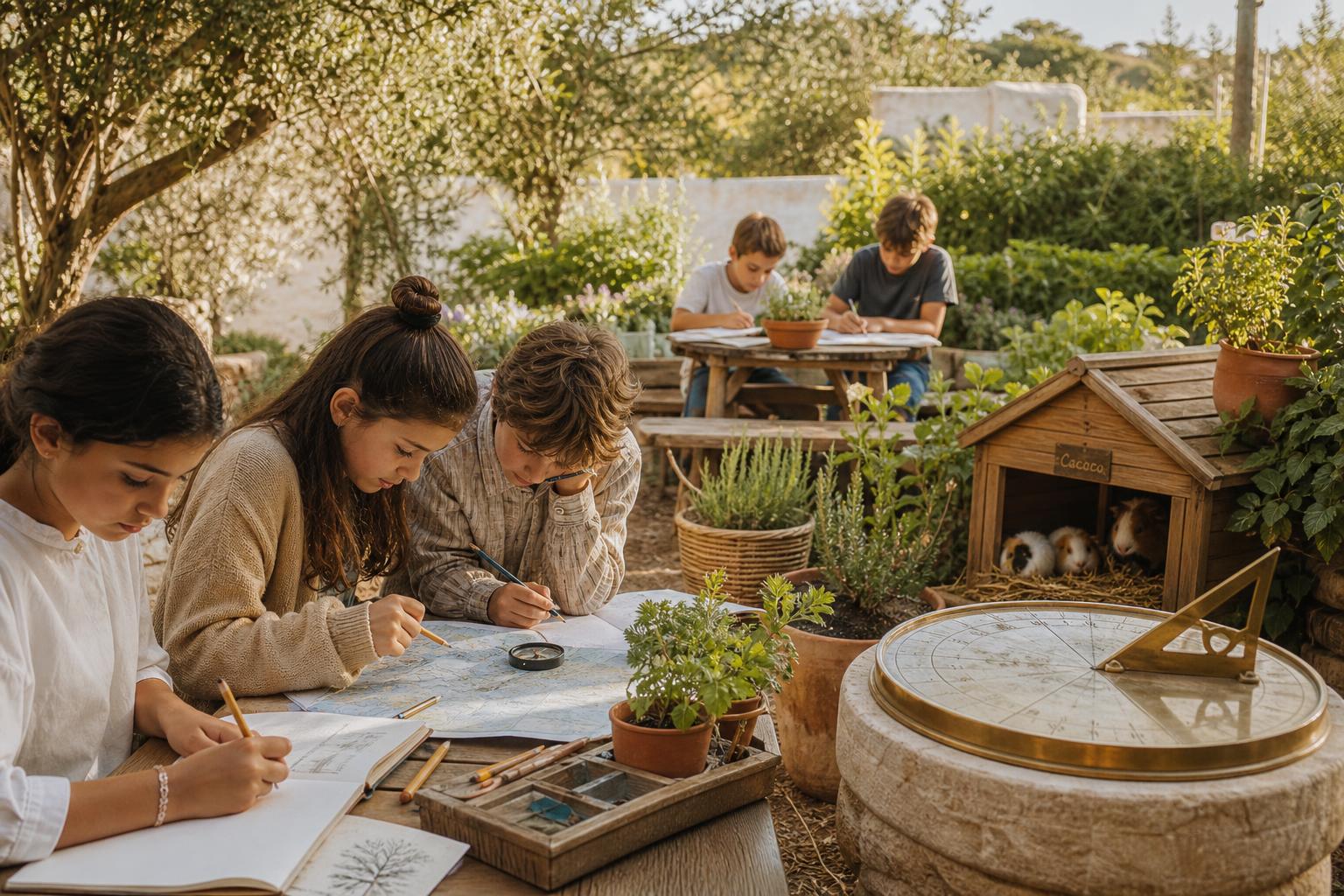
The learning garden

Where inquiry meets the natural world.

Our garden is a living classroom, kitchen beds, a sundial for tracking time and direction, and a guinea pig hut that teaches care, observation and responsibility.

Students ages 10–12 exploring maps, direction and sundials in the garden, journaling, sketching and collaborating in small groups

Small groups lead their own inquiry, reading maps, observing shadows on the sundial, sketching plans, and documenting discoveries, in a calm, natural studio garden where direction, place and time are explored hands-on.

In depth

Explore each day of the week

Tap a day to read more.

For families

Want to know more? Book a call with Nichola.

A relaxed conversation with Nichola, before anything is decided. Ask about the studios, the daily rhythm, the fees, or what your child would find here.

Every enquiry is answered personally, usually within two working days.

How we measure our success

Academic excellence.
Never compromised.

We can only learn when we are willing to take risks, and we can only take risks when we feel confident and known. That is why belonging and rigour are not opposites at ISI. Academic excellence is a key driving indicator of how we measure our success as a community.

Curiosity is what we light first. Our unique PPPP™ compass, Purpose, People, Place and Practice, is how we keep learning relevant, meaningful, significant and challenging for every child, so rigour is felt as wonder, and challenge becomes something children learn to meet with growing skill, stamina and confidence.

01

Rigour, never compromised

High expectations in literacy, numeracy and conceptual understanding for every child, assessed against international IB-aligned standards and tracked with evidence over time.

02

Strengths first

We begin with what a child can already do. Strengths-based teaching is linked to higher engagement, persistence and achievement, so we build from strength towards stretch.

03

Courage to take risks

Learning happens at the edge of what we know. Children who feel safe to be wrong attempt harder problems, and mistakes become information, not judgement.

04

Confident lifelong learners

Self-efficacy is one of the strongest predictors of achievement. We measure growth in what each child can do, and in how confidently they choose to keep learning.

Research · Bandura on self-efficacy · Hattie, Visible Learning · Seligman & positive education on strengths-based practice · Dweck on learning from mistakes

Our Mission

When the Child Belongs, the Community Thrives.

Three commitments

Three commitments that bring ISI Cascais and DeMontaigne Life Design together.

“We hold one standard above all others: that every child belongs, deeply, visibly, and before anything else is asked of them. Three studios, flexible ages, one question that guides every decision: does this genuinely serve the child, the family, and the wider community, over time?”

In partnership with DeMontaigne Life Design ↗